Money and gold
Money exists and has value because we agree that money exists and has value. Before we collectively accepted this agreement, we dealt in gold. This makes some sense, for gold is rare, it doesn’t spoil, and it’s easy to chop into bits or melt into shapes. Plus, gold is easily distinguished from other metals, which makes faking it difficult.
However, gold is also heavy, so not very convenient when you want to go shopping. Thus (at least, so we’re told) money initially appeared as a solution to gold’s inconvenience, serving as a ‘representative’. Metal coins and paper notes were given a value equivalent to a specific weight in gold, and this made gold a backup or ‘reserve’.
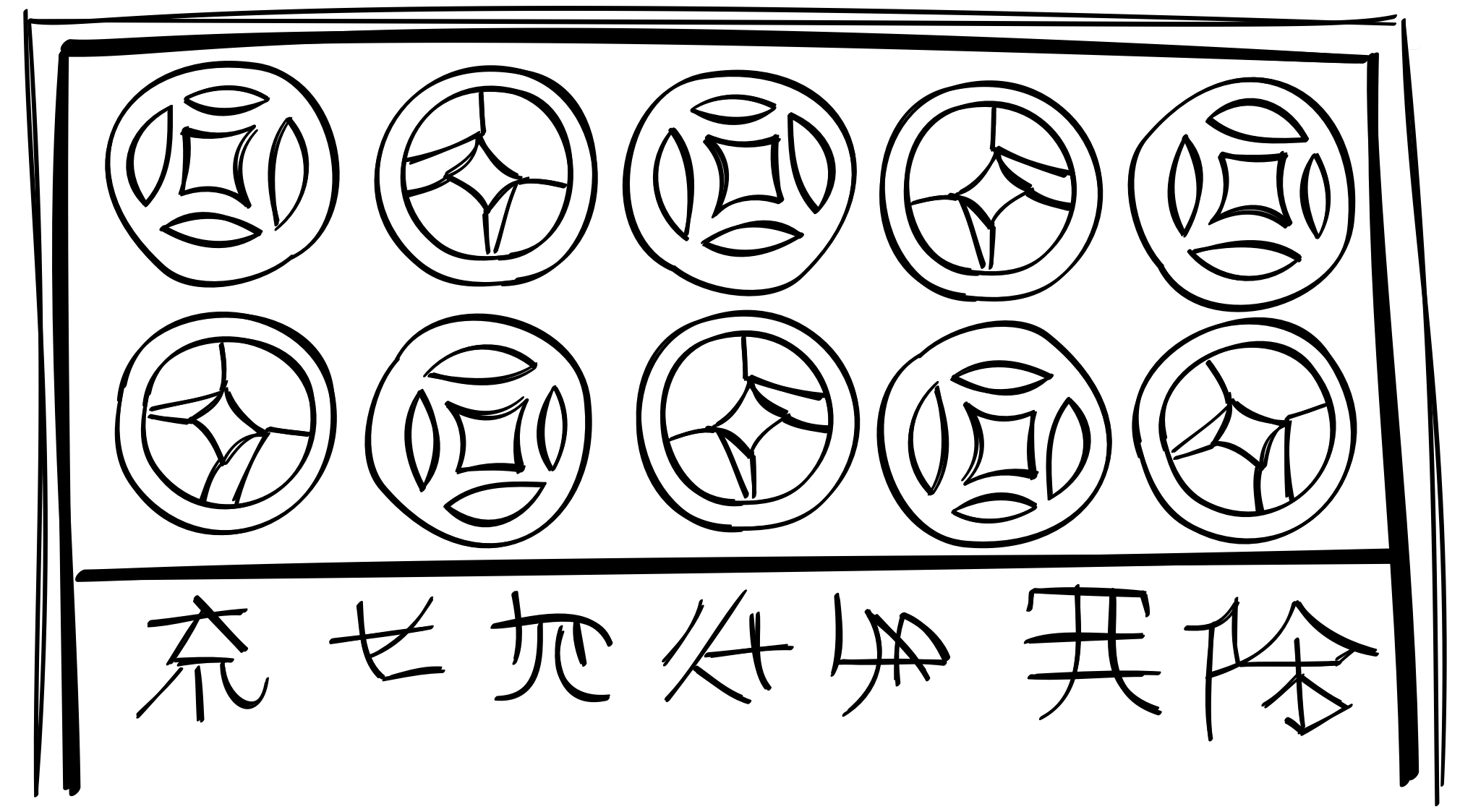
Detail of a jiaozi, the world’s earliest known money note. This paper money appeared in China around the year 1000, initially because of a shortage of copper to mint new coins.1See En.wikipedia.org/wiki/Banknote#Early_Chinese_paper_money.
The year 1871 saw the invention of the international ‘gold standard’. The standard was supposed to provide security and stability, partly by ensuring that no more money would be created than the known corresponding amount of gold on the planet.
When almost sixty years later the US stock markets crashed and the world slid into an economic downturn, people no longer dared to build on the financial system. Crowds flooded the banks to exchange money for gold. Governments became nervous, and in 1976, after a lot of political wrangling—including attempts to still make something of the gold standard, money was de-coupled from gold. From that moment on, money could be created at a whim and without limit, making it easier for governments to influence economies.2Information on the gold standard came from En.wikipedia.org/wiki/Gold_standard and Investopedia.com/ask/answers/09/gold-standard.asp, among others.
Now, here’s the funny thing: de-coupling money from gold could have made gold almost worthless, which it factually has always been. Gold may be rare and non-perishable—it’s also too soft to build with and too hard to eat. Gold is one of the least usable metals on Earth. Still, people killed for it before 1976 and have continued to kill for it ever since, for one simple reason: once upon a time, we agreed that gold is worth its weight in gold.
In short, the gold standard was an agreement based on a value perception with almost no real, applicable foundation. Yet legions of people still believe in the agreement, digging holes in the ground to mine gold to transport and store that gold in other holes called ‘vaults’. You can still get a virtual hold of that gold by buying it with money, but since you’ll never get to see it, you’ll never know whether it exists. And even if it does, ‘your’ gold is only useful to you for as long as the agreement that gold is worth its weight in gold is honoured.
To go even shorter, if you’re under the illusion that you’re securing your financial or material capital by exchanging it for gold, you’re fooling yourself just as severely with gold as you did with money.
I want to make a note about agreements: there’s nothing innately wrong with them. I find agreements super handy, provided they mean something and help us. The problem—at least, with most of the common and collective agreements around work, life, parenting, education, money and gold—is that they don’t.
They trap us.
_
- 1
- 2Information on the gold standard came from En.wikipedia.org/wiki/Gold_standard and Investopedia.com/ask/answers/09/gold-standard.asp, among others. ↩︎
