Trading with interest
That eleventh note, the one that has to return to the man with the shiny shoes, has a name.
Interest.
Interest seems to do something funny, because as soon as it enters the game, players start changing their behaviour. Where before you were able to trade your stuff for an equal amount of other stuff,

you suddenly need to trade your stuff now for more stuff later.
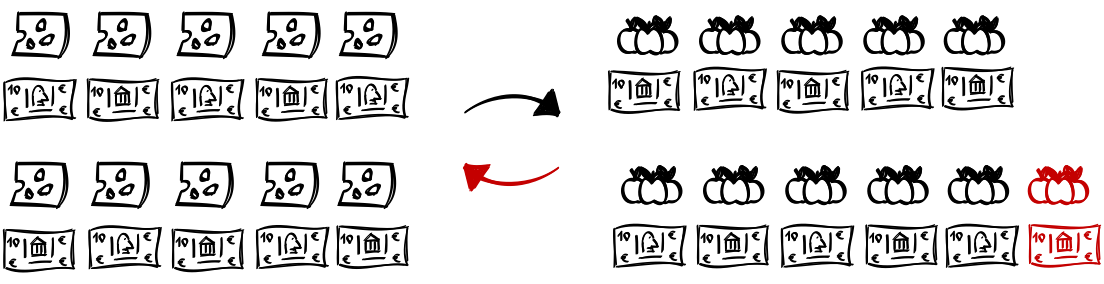
That extra note, the one you don’t have but soon need, creates a lack—or, better said, an illusion of lack. After all, the man with the shiny shoes doesn’t factually change anything in the village. It’s the deal he summons, along with your agreement to that deal, that creates a shortage. A second ago you had enough; suddenly you have too little. Yesterday, you didn’t know what ‘negotiating’ means; today, negotiating seems a necessity.
Now, there’s a lot in this that we could argue with. I, at least, can come up with three objections:
- ‘I didn’t borrow any money. My money is mine, so to hell with people who want an eleventh note from me.’
- ‘The world doesn’t stop where the village ends. Extra things can always be made and extra money can always be found. So what do you mean, lack?’
- ‘Okay, so we’ll have to do more later than we do now. What’s wrong with more? Why settle for the status quo when we can make things nicer, faster and more? Isn’t that what we have talents for?’
All three objections make perfect sense to me—until I start dissecting them.
So let’s dissect the objections one by one.
‘I didn’t borrow any money.’
The word ‘interest’ is typically married to the word ‘loan’. A loan brings debt and debt brings interest. If there’s no loan, there’s no debt and no interest to pay.
At least, that’s what I would say, but in the world of money, this logic doesn’t apply. Money in your wallet and bank account, whether you borrowed it or not, is in fact a debt, accompanied by an obligation to pay interest.
How is this possible?
Almost everywhere in the world, money is born as an interest-bearing debt. Every euro, dollar, yen, pound, et cetera came into circulation because someone, somewhere, borrowed it from a bank—with an obligation to pay interest. Virtually all of the money currently in circulation must go back to a bank sooner or later, with interest.
‘So what?’ you may ask. ‘What can those few per cent make me?’
Well, more than many people think. Let’s say, for example, that you want to buy a house, and to do this, you take out a thirty-year loan. At the end of those thirty years, you’ll have had to pay back two to two and a half times the borrowed amount. A few per cent, on top of a few per cent and that every year, automatically grow into a mountain.

Now here’s the thing: you decide to take out a loan. Whether you feel free or unfree in signing the deal, you agree to give back more than you receive. So, you can decide not to take out a loan, and you can decide not to give a crap about your money being an interest-bearing debt—it’s yours, so no one can ask it back, let alone oblige you to pay interest.
Makes sense, again.
But.
There’s another form of interest, one I don’t think anyone signs up for willy-nilly:
Inflation is so normal that hardly anyone questions it. As a child, for instance, I knew it wouldn’t take long before this little ice lolly we in The Netherlands call ‘a double rocket’ would cost not thirty-five guilder cents (about 15 euro cents) but forty guilder cents. I didn’t ask why because this is what I’d learned: things become more expensive every year.
A quarter of a century later and curious about the double rocket trading price, I discover the following:
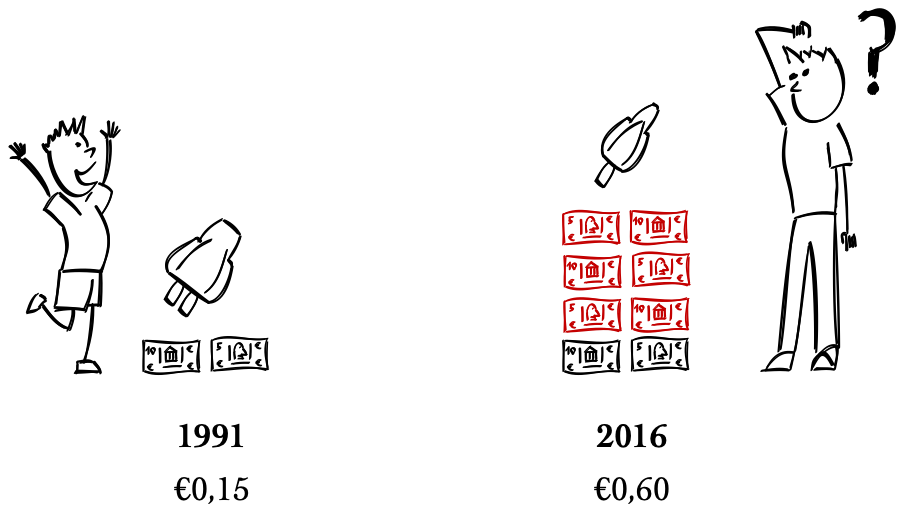
Four times as much for half of the same. Just because things get more expensive every year. Makes sense, right?
Um…
No.
Or…
Yes?
…
Actually, we have no idea.
So-called experts suspect that inflation happens when the amount of money in a country grows faster than that country’s economic output. Here’s their reasoning: as soon as people have the money to buy more, they usually start buying more, but if more things are not immediately made, they want to buy more than can be bought. For many entrepreneurs and retailers, this means the following: ‘Okay, if people are so eager and I don’t have more than I have, I’ll just jack up my prices. Earn mah-self a nice lil’ extra.’
As a buyer, you now need more money for the same thing, which makes your money’s ‘purchasing power’ go down. And this happens everywhere in every trade. For example, house prices go up when there are more home buyers than houses for sale. Home buyers see this happening and start bidding over each other, increasing house prices further. Homeowners who see this extra increase happening think, ‘Now’s the time’, put their houses up for sale, sprinkle some more on the price they think they can get, and so on.
And here’s another cake: business owners, retailers, estate agents and homeowners raise their prices yearly anyway. After all, ‘Things become more expensive every year’, even for people who sell things, so they’d better prepare for that.
To summarise:
- When we gain more money to buy things, but more things are not immediately produced, then demand exceeds supply, so sellers raise their prices and our ‘purchasing power’ goes down.
- Things become more expensive every year because people expect things to become more expensive every year.
Are these the two causes of inflation? Are there more? I haven’t yet met or encountered anyone who knows. What is known is that central banks tend to promote and even influence inflation, because whenever there’s inflation, shopkeepers and entrepreneurs raise their prices, and when prices go up, people work harder to keep buying the same things, and when people work harder, the economy grows faster.
And why do we want the economy to do that?
I’ll keep that question for later on in this chapter. For now, let me say that inflation is a lovely idea—until we turn the coin around. Inflation means that ‘our’ money constantly becomes worth less. In other words, everyone on a fixed income becomes poorer every year.
Inflation is interest in disguise.
Using money means trading with interest.

‘Wait a minute,’ you might now say. ‘What if I didn’t borrow money AND there’s no inflation right now? Then I won’t pay interest, right?’
Alas.
Companies often take out loans to buy things with which they can make products or provide services. And since companies almost always collaborate with other companies, a whole chain of loans runs from raw material to finished product.
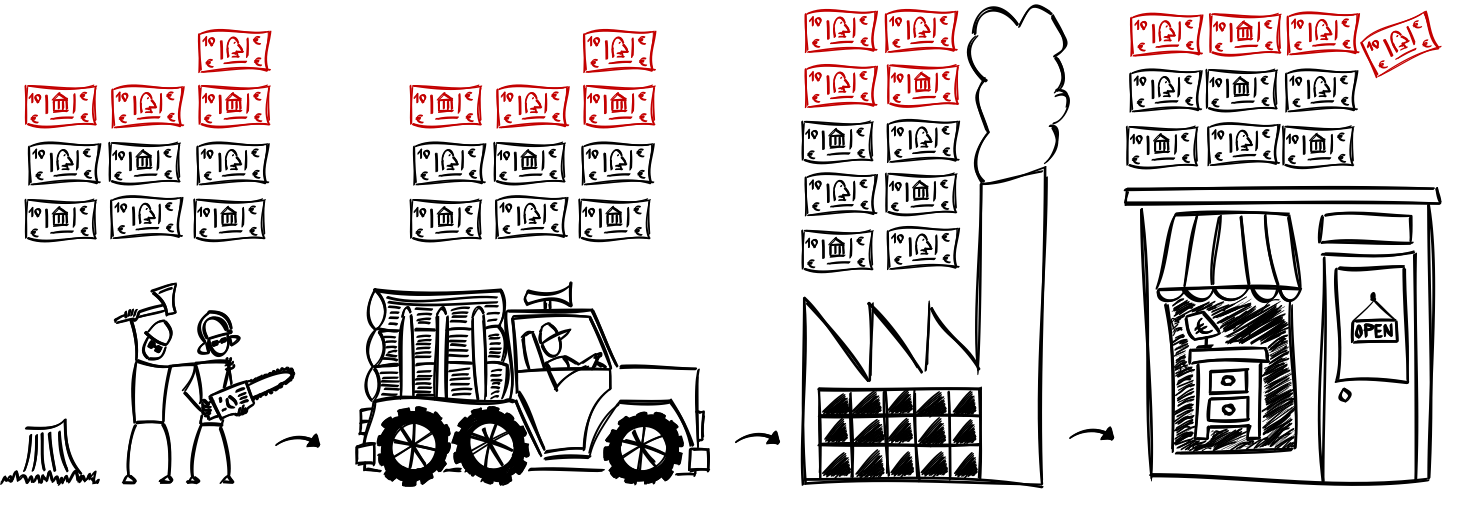
By the time products and services reach the retailer, an average of 35 to 40 per cent of the sales price is a pass-through interest charge.1These figures come from Margrit Kennedy’s book Occupy Money. She bases it on a 2006 study. Figuring the thing with interest rates, the percentage will be higher than 35 to 40 per cent by now. For more about her book, see Newsociety.com. That is to say, 35 to 40 per cent of all money spent is used to pay back interest on loans.
So even when we haven’t borrowed any money, there’s no inflation, and we only use it for innocent shopping, a big slice of ‘our’ money consistently rolls from the high street to Wall Street.
And even this we can turn into a non-issue. ‘Why not just wait,’ we could ask, for example, ‘until everyone has neatly paid off their loans?’
Alas. Not an option.
At least, not with the money currently in circulation.
Everything that’s made and sold globally has more than three times as much debt sticking to it. In other words, for every euro, pound, yen, dollar, etc., that changes hands, more than three have to return to a bank.2
Victoria Masterson & Madeleine North, ‘What is “global debt”—and how high is it now?’ World Economic Forum, 21st December 2023, Weforum.org.
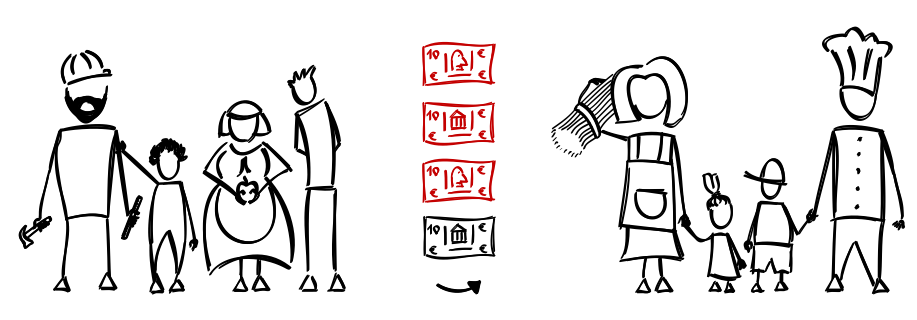
Or, said more easily:
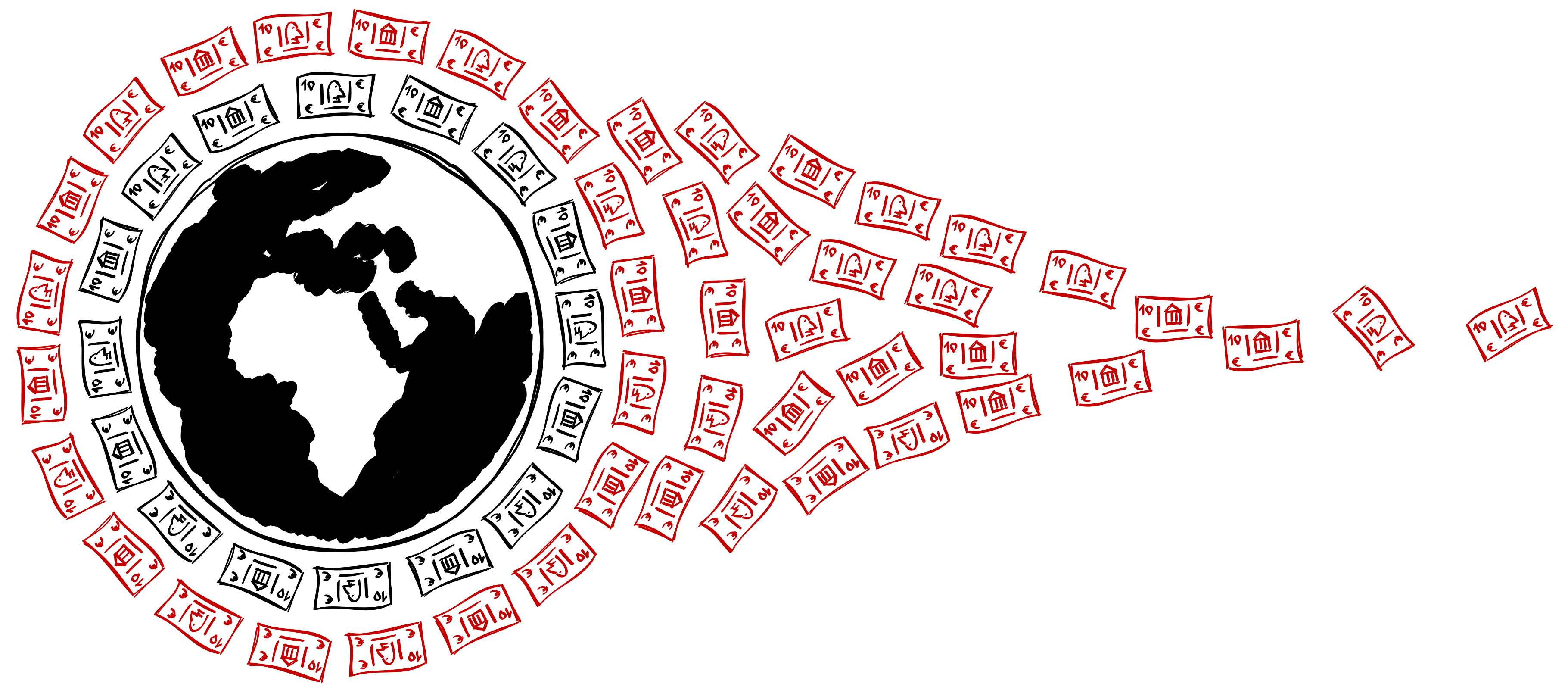
So, no matter how I flip the coin, each side tells me the same story: ‘Our’ money, borrowed or not, is a debt with an obligation to pay interest. If you choose to use a means of payment accepted by the banks—which almost everyone does, making it somewhat challenging not to, you’re effectively trading in debt and working for debt. If you also choose not to make more money every year, you’re effectively making yourself poorer every year.
_
- 1These figures come from Margrit Kennedy’s book Occupy Money. She bases it on a 2006 study. Figuring the thing with interest rates, the percentage will be higher than 35 to 40 per cent by now. For more about her book, see Newsociety.com. ↩︎
- 2
Victoria Masterson & Madeleine North, ‘What is “global debt”—and how high is it now?’ World Economic Forum, 21st December 2023, Weforum.org. ↩︎
