
Let’s briefly summarise the dissection of argument one opposing the story in the village, ‘I didn’t borrow any money’.
- ‘Our’ money, even the money we never borrowed, is a debt with an obligation to pay interest, on top of a debt with an obligation to pay interest, on top of a mountain of debts with obligations to pay interest.
- The only way to pay off all these debts is by taking out new loans, with obligations to pay interest…
- which means there’s always more debt than money…
- which means we always need more than there is.
Yeah, okay, so what? This still doesn’t create a lack. After all, when I look at argument two, extra things can always be made and money can always be found somewhere. So…
What do you mean, lack?
This question edges us onto muddy terrain. We can’t just go on borrowing endlessly, right? And if we continuously have to pay interest on everything, all of the money in the world will at some point run out, right?
No.
Something that could have been made and kept simple has been made incredibly complex. For example, as a child, I once thought, ‘When I grow up, I will visit a bank to borrow money so I can buy a house. The bank will be able to lend me that money because someone who didn’t need it put it in a savings account. So really, I’ll be borrowing from someone and not from the bank. I wonder who that someone will be.’
I still think this makes so much sense. To give another example: I can’t borrow a drill from you if you don’t have one. So money, too, I should be able to borrow only from people who have it. But here’s where things start becoming wonder-filled: bankers have a power that ‘ordinary’ people don’t—the power to create money. Banks are allowed to create money at will and credit that money to our account, until they have only a fraction (usually around 10 per cent) of the created money in reserve. This process is called ‘fractional reserve banking’ and is best explained as follows.
John Doe puts twenty thousand euros in a savings account. For this, he receives a few per cent interest per year (if he’s lucky, because in recent years, inflation rates almost always top prevailing savings rates). The bank can immediately use these twenty thousand euros to ‘create’ nine times as much and lend the resulting amount to you, with an obligation to pay interest.

Coming back to that thirty-year mortgage: you don’t just spend thirty years paying back what wasn’t there in the first place; you also spend thirty years paying interest on what wasn’t there in the first place.
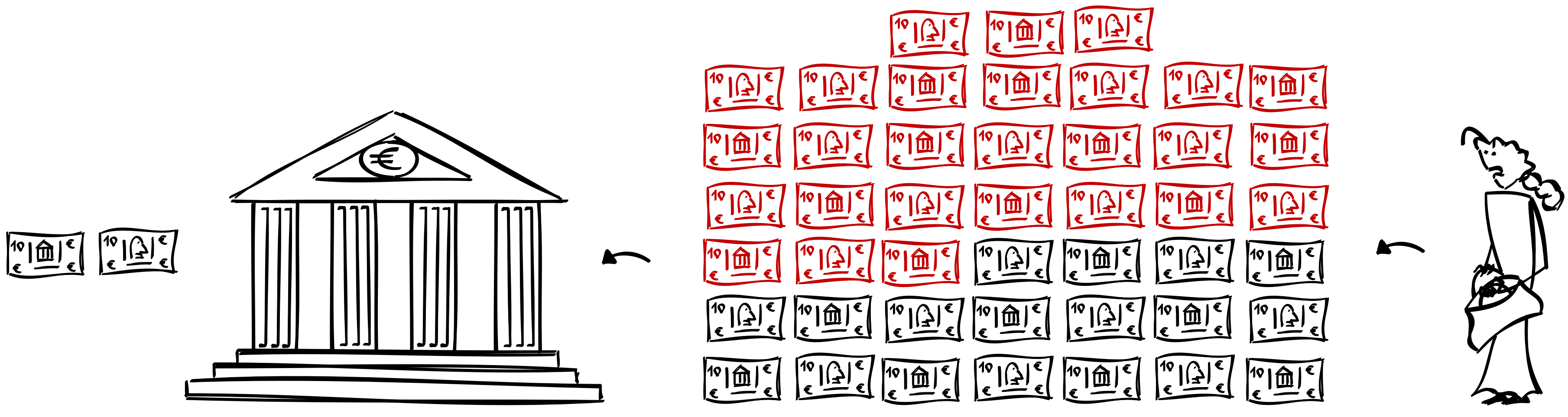
Now, officially, the bank has to ‘destroy’ (i.e. wipe out or disgorge) the money you repay, so that what wasn’t there in the first place isn’t there again when you finish repaying. But the interest you repay, the bank can keep, and this part of your repayment can pile up to one and a half times the amount you borrowed.
In other words, by the time you ‘give’ back the last part of your loan, you’ll have ‘repaid’ the bank nine hundred per cent, times one and a half, of John Doe’s savings as interest.
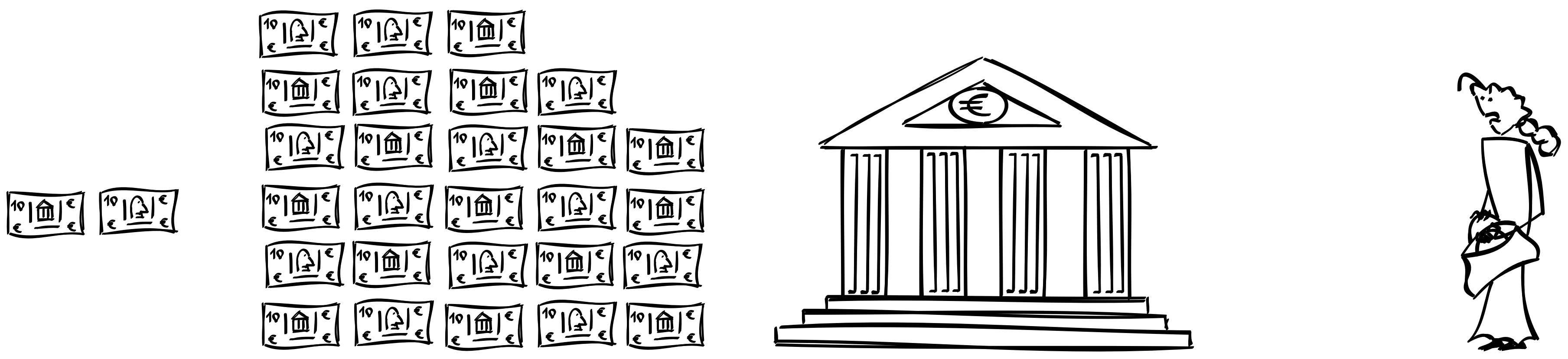
And the wonderfilling doesn’t end there, because every time you repay a piece of loan with interest, the bank may immediately create nine times as much of the interest you paid and lend it to someone else. With an obligation to pay interest.1See Heidi Leenaarts, Onze economie opnieuw uitvinden (‘Reinventing Our Economy’), available via UnitedEconomy.nl.
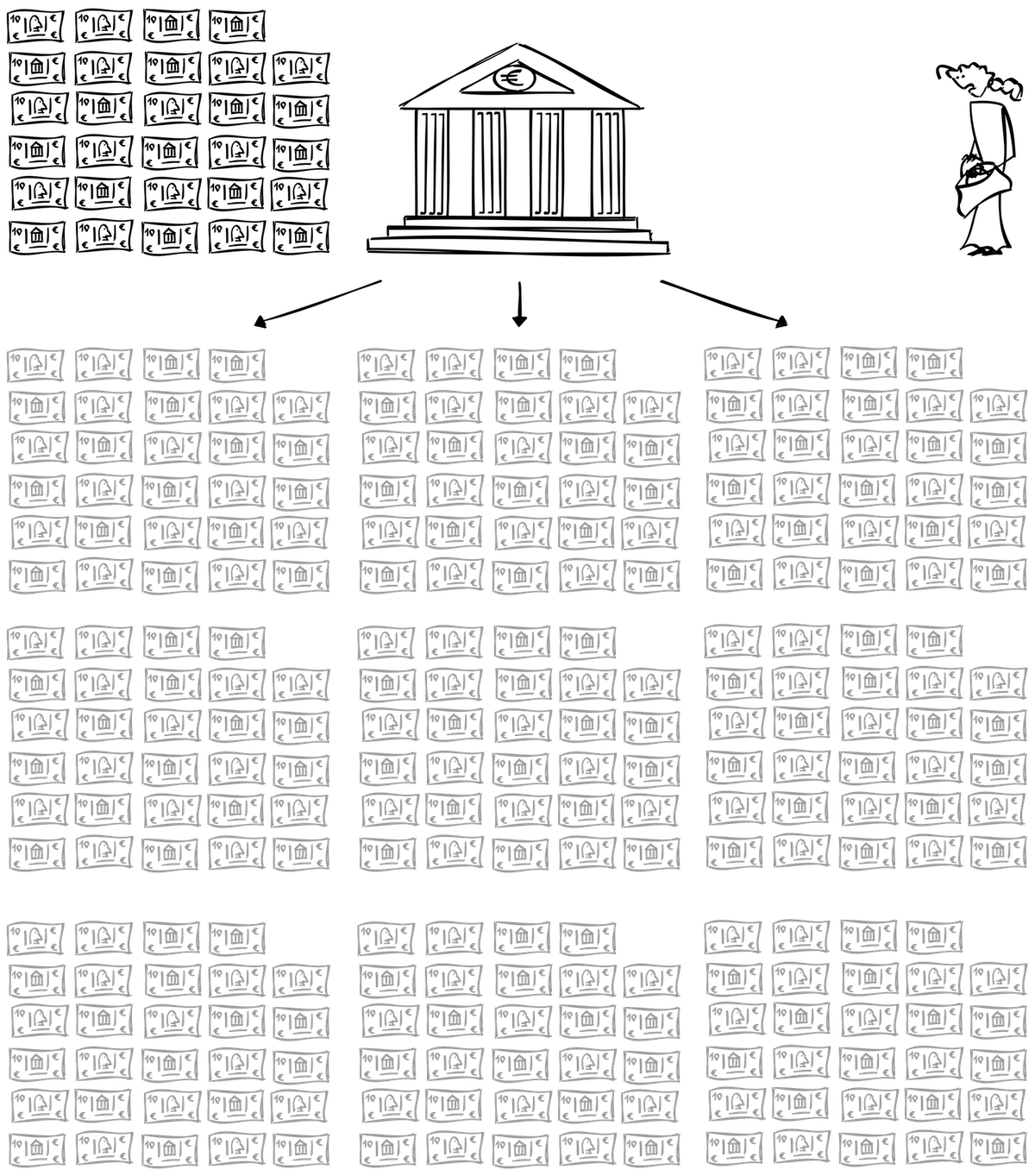
If I extend this logic to people and drills, we get the following situation:
- I lend you a drill that I don’t have.
- We agree that you’ll give back this drill, plus an extra drill, plus an extension cord and some accessories.
- Once you’ve done so, I will re-lend that extra drill-plus-extension-cord-and-accessories to nine people simultaneously, under the same conditions under which I lent you a drill I didn’t have.
It’s a miracle, and as it turns out, even more miraculous, because banks don’t need John Does with savings to lend money to people. Banks can request almost unlimited ‘advances’ from their country’s or continent’s Central Bank. For every loan banks make, they apply for such an advance. And where do Central Banks get these advances from? Heidi Leenaarts, author of the book Onze economie opnieuw uitvinden (‘Reinventing Our Economy’), told me that even she doesn’t know all the ins and outs.
So, instead of going deeper down this rabbit hole, I’m going to move to another.
Somewhere in recent times, bankers got the idea of reselling outstanding loans to investors and speculators. And of course! Why take money from one side when you can take it from two?
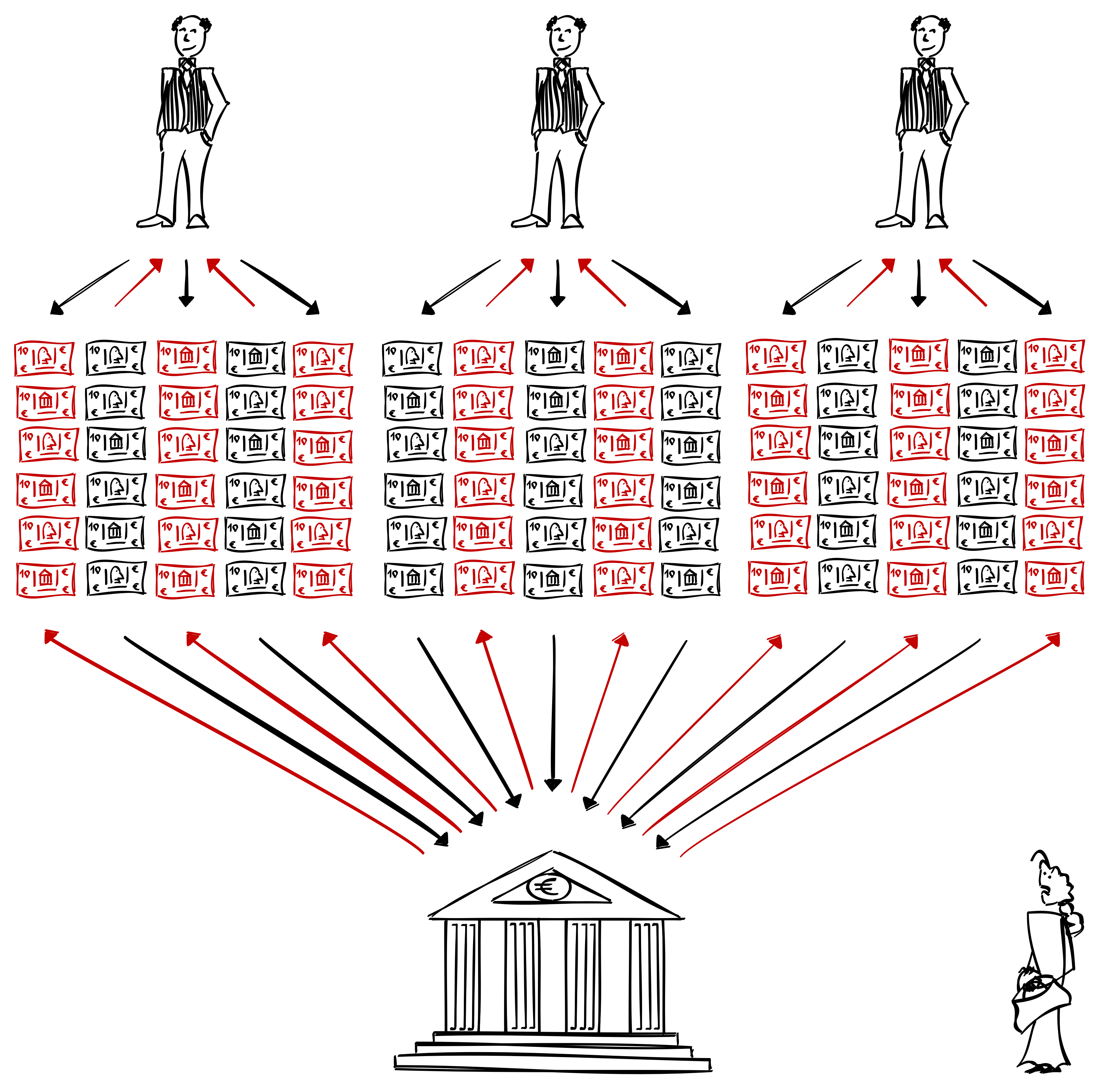
Perhaps needless to say, investors and speculators make their living by buying things and reselling those same things for more money, among other places on the stock market. By capitalising on what they think will happen to a stock price (or, in the case of fraud, already know what will happen), they ‘create’ enormous profits, in no time, out of nothing.
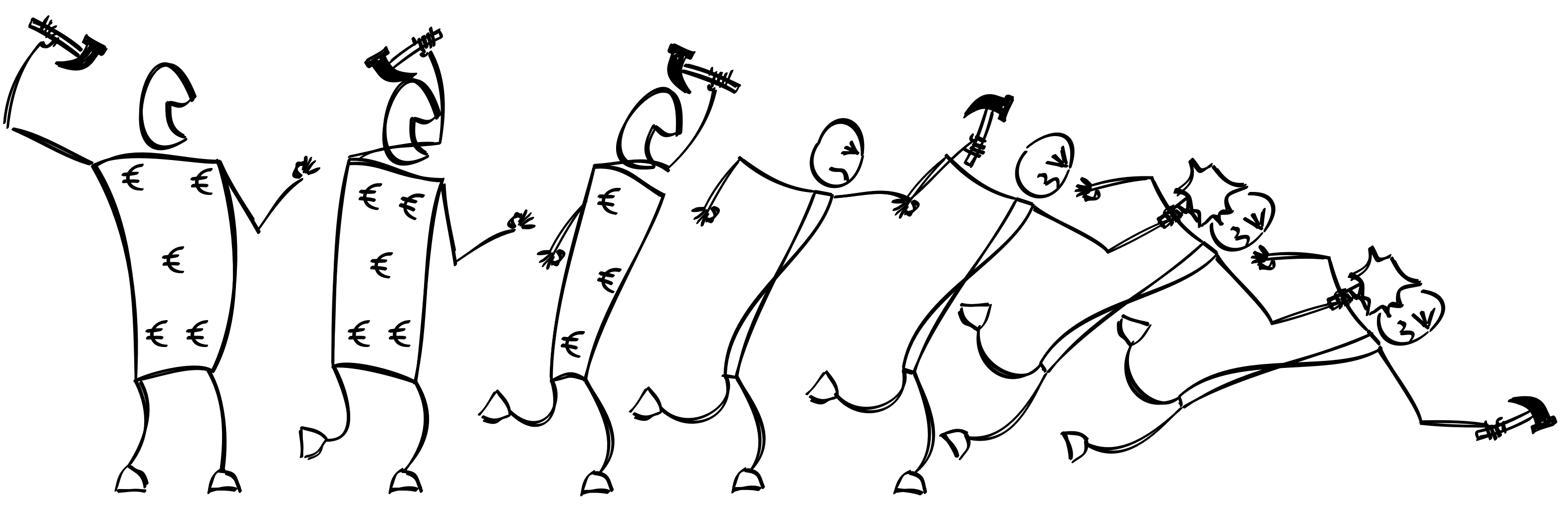
How does this ‘investment’ game work when someone speculates with money that didn’t exist, was lent out anyway and hasn’t been repaid yet? Pfff… Here, too, I stopped digging. What I learned is that this reselling, re-speculating and over-investing of loans went on for years and years, under the radar and without a hitch. Quietly, a long line of interest-bearing debts grew, and then, in 2008, things started faltering. People at the back of the interest line lost their jobs, had spent money they didn’t have and were broke. Since they could no longer repay their loans, all the loans taken out to make their loans possible could also no longer be repaid. The same went for the loans before these loans, and so on.
When word hit the street, all hell broke loose. Suddenly, the whole world saw the thin thread holding billions of loans. Confidence in the financial sector took a dive, stock prices plummeted and bad loans toppled like domino bricks. Millions of people lost their homes and even more millions lost their jobs.2See, for example, John Cassidy, ‘The Real Cost of the 2008 Financial Crisis’ in The New Yorker, 10 September 2018, NewYorker.com; Laura Paddison, ‘9 Faces Of The 2008 Financial Crisis: The Winners, The Losers And Those Left Behind’ in HuffPost, 14 September 2018, HuffPost.com.
When even the big international banks threatened to fall over, the European Central Bank, the US Federal Reserve and the International Monetary Fund came to the rescue. Their plan? To waive debts—not for broke people, but for the banks. This was the only way to avoid a global financial meltdown. At least, according to the rescue party.
In addition to the waivers, banks received huge cash injections, mostly from governments that took out loans for the occasion, with an obligation to pay interest, so the banks in their countries could continue lending money.
A small number of people were charged with fraud. Some paid a fine; a few were sent to jail for a while; the majority got away with a scare. And the prominent leaders in the game? They continued to work in the financial sector.
Things calmed down, consumer confidence rebounded, and economies started growing again.3See above articles in The New Yorker and HuffPost.
Except in Iceland.
I’m going to quote from De Prins van Fillettino (‘The Prince of Fillettino’), a novel written by Flemish author Geert Kimpen, based on the true story of an Italian mountain village that created its own currency. To me, the book is a touching, painfully hilarious and poignant manifesto, which includes the following conversation between an investigative journalist called Sergio and a bank manager.
‘Surely, as a financial man, it should interest you why Iceland is the only European country with a budget surplus right now—in full crisis.’
—‘A budget surplus? Why isn’t that in the papers?’
‘Perhaps because you’re reading the wrong newspapers,’ Sergio smiled. ‘Iceland, too, took a blow in 2008, just like the rest of the world. The bubble burst. And do you know what the new Icelandic government did? It cancelled all mortgage debts above 110 per cent of borrowed money! All debts above 110 per cent of the value of houses need not be repaid.’
—‘I beg your pardon, what a ridiculous measure! We’d go bankrupt if we followed their example!’
‘Exactly. In a few months’ time, Iceland let the three biggest banks go belly up. A move that other European countries claimed would lead to the End of Time. The International Monetary Fund was furious. It wanted to lend billions to save the Icelandic banks, as it had done to all other countries. Loans that, of course, would have to be repaid by Icelandic citizens, who said, “Thank you, but no thank you.”
‘And in contrast to all other countries, the bankers who caused the blow were arrested and held accountable. Most of the unemployed in Iceland are now bank employees, not ordinary people. This is why Iceland is the only country already out of the crisis, while the rest of Europe is still up to its neck. And they partly owe this to their currency, the Icelandic króna, which they can influence themselves. There’s not an Icelander left wishing for the euro.’4Translated from the original Dutch book by Geert Kimpen, De Prins van Fillettino, De Arbeiderspers, 2013.
In Iceland, the monstrous growth of debt was halted. Icelanders repay only what is humane and no more.
Outside of Iceland, humane doesn’t seem to apply.
So, coming back to argument two against the story of the village, ‘What do you mean, lack?’: money is indeed always to be found somewhere, if not in the village, then outside of it. So, of course you can pay the man with the shiny shoes ‘his’ eleventh note. Even if you fail to do so on time, no sweat. The man with the shiny shoes will simply say, ‘Here, extra money, with an obligation to interest. If you can’t pay me again next time, that’s okay too; I’ll just confiscate your house.’
This is ‘our’ money.
This money we call a medium of exchange.
This system we call ‘financial services’.
I see plenty of finances, but I fail to see the service.
It’s sad, because like money, banks and bankers are an excellent idea. How wonderful, when you have more money than you need, to find a banker who says, ‘I know people who can use your money in positive and constructive ways—I would like to connect you.’
To me, this is the beautiful essence of banking: connecting gifts, talents, positive needs and creative possibilities. Helping people to find each other, fuel each other’s ideas and make dreams come true.
And as in banking, so in interest. Going to the core, interest is an appreciation someone receives for the connections they make. An appreciation that he or she can use for sustenance and livelihood, which thus flows back into a tribe, village and economy for further circulation.
That the practice of banking and interest is often a completely different cookie doesn’t automatically make banks, bankers, and people with a lot of material assets crooks. It makes them part of a deeper, collective pattern.
Which brings us to argument 3.
_
- 1See Heidi Leenaarts, Onze economie opnieuw uitvinden (‘Reinventing Our Economy’), available via UnitedEconomy.nl. ↩︎
- 2See, for example, John Cassidy, ‘The Real Cost of the 2008 Financial Crisis’ in The New Yorker, 10 September 2018, NewYorker.com; Laura Paddison, ‘9 Faces Of The 2008 Financial Crisis: The Winners, The Losers And Those Left Behind’ in HuffPost, 14 September 2018, HuffPost.com. ↩︎
- 3See above articles in The New Yorker and HuffPost. ↩︎
- 4Translated from the original Dutch book by Geert Kimpen, De Prins van Fillettino, De Arbeiderspers, 2013. ↩︎
