Talent and wealth
Back to the village. Before the shiny shoes walked in, you lived together and gave to each other, which was fun, rewarding and perfectly logical. After all, how wonderful is it to give to your fellow human when you have too much, and how wonderful is it to receive from your fellow human when you have too little?
This logic applies to much more than food and stuff. In the words of a tribal elder from Greenland called Angaangaq:
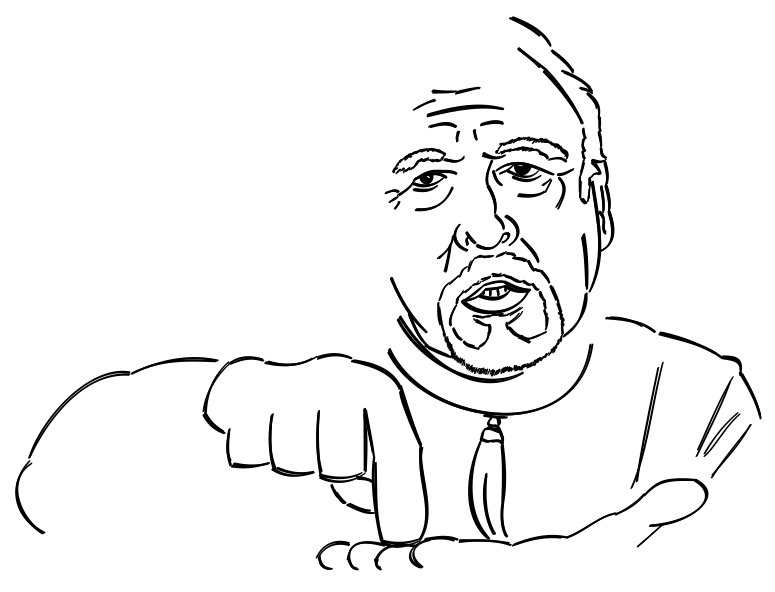
‘The more I share my knowledge, the wealthier I become. And, of course, the wealthier I become, the more giving I can be. The more I give, the more I get. It’s like a circle, with no beginning and no end, in which we all belong.’1People from the ethical Triodos Bank asked Angaangaq: ‘How do you become rich, really?’ The short video with his answer can be found at MiracleProject.earth/really-rich.
Do you become less when you share knowledge someone else doesn’t already have? No. Sharing enriches both the giver and receiver. That is, until money—pardon me, interest—enters the game. Suddenly, holding on doesn’t seem so crazy. Milk will go sour, turn into cheese, and then rot, but money has no best-before-date. You don’t need to use a surplus of money for it to keep its value.
So here’s what happens: wherever interest determines the rules (which it does almost everywhere on Earth), money mostly rolls to people skilled at multiplying it. It rolls less to not-at-all to people who merely want to do something beautiful and sound with it. To boot, the more money people own, the easier it is for them to multiply it. As French economist Thomas Piketty says about his homeland:2From an article by Pieter Giesen, ‘Slapend rijker’. De Volkskrant, Saturday 19th April 2014.
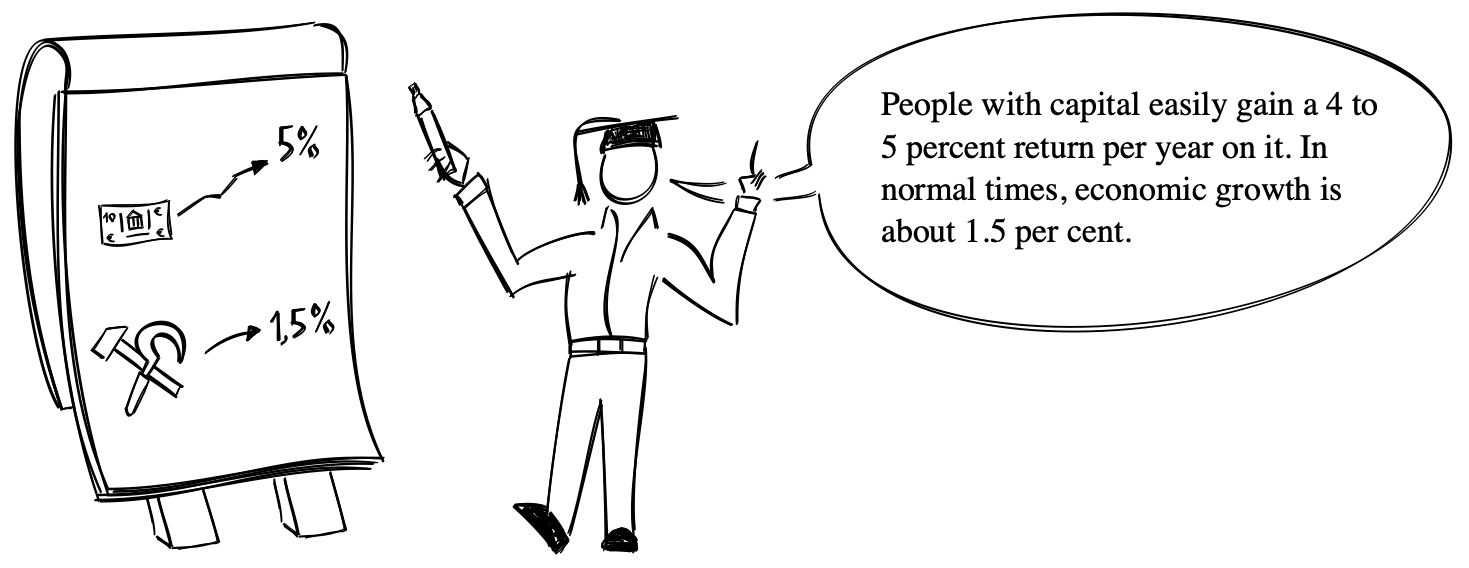
In other words, having money almost automatically ‘earns’ you 2.5 to 3.5 per cent more than working for money.
There’s a similar trend in the country I hail from. Between 1980 and 2018, inflation levels in The Netherlands were about the same as the income increase for people in paid employment. Effectively, people in paid employment have not become wealthier. Yet in the same time frame, the Dutch economy grew by more than 40 per cent (again, effectively speaking, after adjusting for inflation and also after adjusting for the increased number of households). Put simply, in almost forty years, wages didn’t go up at all, but profits went up by 40 per cent. And who’s redeeming? Capital owners.3Mirjam de Rijk, ‘En de winnaar is… Het zakenleven’. De Groene Amsterdammer, 31st January 2018.
In Angaangaq’s village, people mainly benefit from property by sharing it; in Western ‘developed’ societies, people mainly benefit from property by sitting on it. This profit-from-sitting-on-property has crept into almost everything, even the price we pay for products and services.
In a just society, everyone who adds value to a product or service would receive a fair share of the price we pay for it. In other words, pricing for products or services would be determined by the combined income of all the people who worked on them. In our societies, we price things differently.
- First, there’s the 35 to 40 per cent of retail prices mentioned earlier, used to pay interest on debts.
- Second, there are the actual costs of products and services. In most cases, these costs are much higher than the price we pay for them in the shop. Why? Because we humans have become really good at destroying fellow humans and Nature while producing goods and delivering services. Other people and Nature immediately pay for the resulting damage; we consumers will only pay somewhere in the future, when, for example, our lungs start suffering too much from cleared rainforests and depleted seas.4Trees aren’t the only lungs on our planet. In fact, it’s claimed that most of the atmospheric oxygen comes from oceans. See, for example, Seaspiracy.org/facts & Earthsky.org/earth/how-much-do-oceans-add-to-worlds-oxygen.
- Third, to return to the price we do pay directly: on top of the interest part, another part of the price we pay goes to people who have not actively contributed. These people take a cut purely because they own shares in companies we buy from, or because they receive rent for the land and buildings on which those companies do their thing.
In short, having wealth in the form of money or land almost automatically gives you the gift to increase that wealth. The only talent you need for that gift is the ability to lend out some of your money—with an obligation to pay interest, of course—or to rent out some of your land. And even that talent you can outsource; many a banker, speculator or broker will jump at the opportunity to ‘help’ you.
Globally, the gaining-from-property game is painting a dire picture:
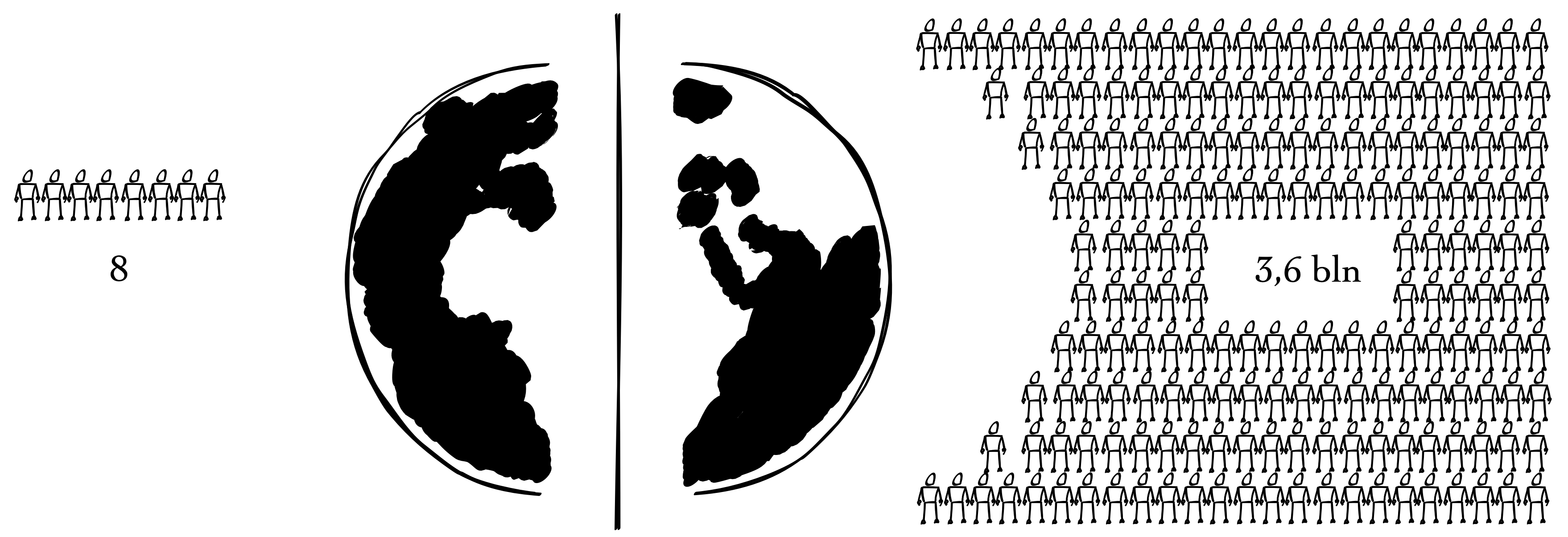
Since 2015, the richest one per cent own more capital than the remaining 99 per cent put together; at the start of 2017, the eight wealthiest people owned as much as the poorest half of the world’s population.5Oxfam Briefing Paper, ‘An Economy for the 99%’, January 2017, Oxfam.org.
About this, French economist Thomas says: ‘We humans don’t object to inequality due to work and merit, but when you have a group of oligarchs who just keep piling up capital… that clashes with deep convictions on social justice.’6Pieter Giesen, ‘Slapend Rijker’. De Volkskrant, Saturday 19th April 2014.
I agree with Thomas’s words, but the biggest clash I feel…
happens on other grounds.
_
- 1People from the ethical Triodos Bank asked Angaangaq: ‘How do you become rich, really?’ The short video with his answer can be found at MiracleProject.earth/really-rich. ↩︎
- 2From an article by Pieter Giesen, ‘Slapend rijker’. De Volkskrant, Saturday 19th April 2014. ↩︎
- 3Mirjam de Rijk, ‘En de winnaar is… Het zakenleven’. De Groene Amsterdammer, 31st January 2018. ↩︎
- 4Trees aren’t the only lungs on our planet. In fact, it’s claimed that most of the atmospheric oxygen comes from oceans. See, for example, Seaspiracy.org/facts & Earthsky.org/earth/how-much-do-oceans-add-to-worlds-oxygen. ↩︎
- 5
- 6Pieter Giesen, ‘Slapend Rijker’. De Volkskrant, Saturday 19th April 2014. ↩︎
