What’s wrong with more?
Every one of the prevailing answers we’re currently inventing to battle an illusion of lack creates a new, greater illusion of lack. The positive name we’ve given to this vicious cycle is ‘growth’. Economic growth is good news; economic shrinkage is bad news. Why? Because we’ve come to associate economic shrinkage with decline, stagnation and decay, while economic growth signifies progress, innovation and prosperity.
And without economic growth, so the reasoning goes, there’s no increase in prosperity. Why? Because our ability to satisfy our needs only grows when the economy grows. This, at least, is the common idea, which is built on two assumptions:
- If we want to create a happy and healthy society, prosperity must increase.
- People don’t pursue prosperity in and of themselves; they need an incentive.
The first assumption I can easily link to a perception of lack. Whatever is there now isn’t enough to be happy and healthy—we need more. The second assumption, ditto. Because as the reasoning continues, we humans only want more when we see ourselves having too little.
This mindset makes lack, or ‘scarcity’, as economists call it, both a problem and a solution. Scarcity encourages us to stop idling, get moving and go forward. And if we don’t see scarcity ourselves, we can be given it through that eleventh note, i.e. an interest-bearing debt, i.e. an artificially created lack.
This problem-solving problem may have served us in a way. We humans have made impossible discoveries, invented bizarrely beautiful things and vastly improved our living conditions.
But what if more is a must?
What if we can no longer do without more?
When, then, will more be enough?
Never.
A growth economy (or, better said, a debt society) is insatiable. Interest and inflation always demand more than they give, so there’s always more that needs to go back into the system than comes out. This creates an enormous paradox: we’ve invented everything we need to live comfortable lives, expending only a fraction of the time and labour we needed one hundred years ago to make ends meet—but are we living more?
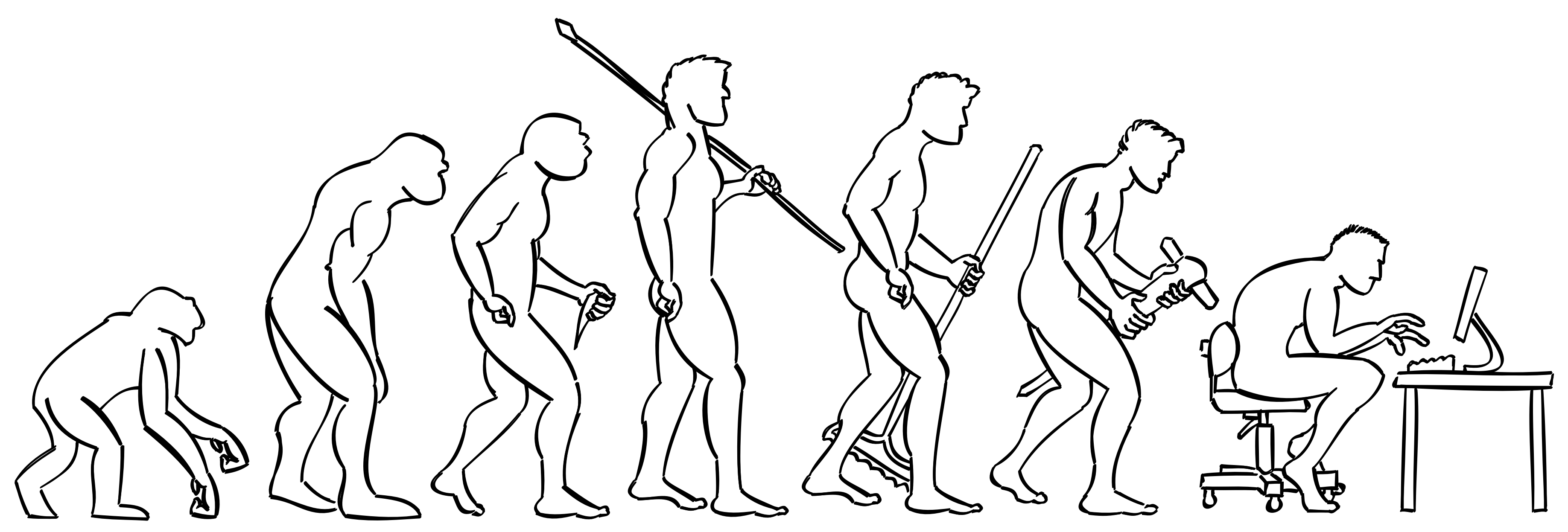
Almost everything that Nature once gave us, plus everything we used to do with and for each other, is now called a product or a service. Clean drinking water, land to live on, food, raw materials, care for older people, childcare and walking the dog… things to buy and sell. The same goes for almost everything we used to make or rebuild ourselves. In all of these areas, we’ve come up with ‘innovative’ solutions…
that are amazing at causing problems.
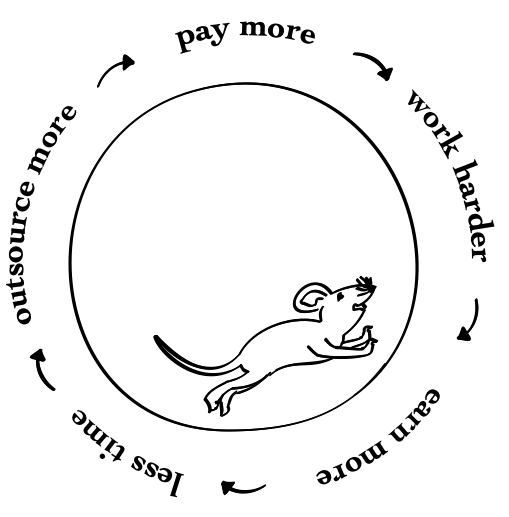
The more we outsource our needs to specialists and professionals, the more we pay to meet our needs, the more we have to earn to meet our needs, the harder we need to work to earn more, the less time and attention we have for things that require time and attention, the more of our time and attention we outsource to specialists and professionals, the more we have to earn to pay specialists and professionals…
As long as more isn’t enough, enough remains a promise, never to be fulfilled. Fortunately for us in the West, we’ve become so skilled at outsourcing that much of the ever-increasing societal pressure has been delegated elsewhere. People in so-called developing countries ask less money, whine less about working conditions, and are more forgiving of our polluting attitudes.
Now, you and I could say, ‘There must be a point at which our needs are met, right?’
Alas—again.
An insatiable system constantly ‘discovers’ new needs. Western and ‘developing’ societies are bursting with products, services, apps and gadgets that didn’t exist a short while ago. All feed into our secret fears and vanities, all work tirelessly to convince us they’re essential and all promise us a more leisurely, richer and safer life. Do they deliver on these promises? Doesn’t matter—what matters is that we pay for them.

Advertising poster for Oasis soft drink, Scotland, 2015. One of the most honest ads I’ve ever seen.
So, in short and in response to the question ‘What’s wrong with more?’:
nothing.
Except in a debt-with-interest-economy.
More and more of everything is burdened with a price tag, not because we want to burden more of everything, and not because it makes things better, but because in a debt-with-interest-economy, more can never lead to enough.
