Not having enough, not being enough
—
Anything we do out of fear of punishment if we don’t—everybody pays for it. Anything we do for a reward—everybody pays for it. Everything we do to make people like us—everybody pays for it.— Marshall Rosenberg
—
Relentless competition blurs the lines between doing, having and being. We learn to gain self-worth, not from an innate sense of worth but from ‘being’ bigger, smaller, smarter, dumber, faster or slower than others. Doing things less well than others makes us less; doing things better makes us more.
Years ago, I would have called this blurring a Western symptom, but I found the blur even in the unlikeliest places.
In 2013, photographer Thijs Heslenfeld invites me to join him in Namibia’s wilderness. Thijs is one of the people we put on film for the Heartworkers project, and because I’ve gotten to know him a bit since then, I also know that when he talks about wilderness, he means it.
On our first day together, with nightfall drawing near and a few metres from where we spotted lions’ footprints, Thijs smiles and announces, ‘Let’s set up camp for the night.’
Namibia is the second-least densely populated country in the world. Its emptiness is one reason why Thijs is so taken by it. But even in this emptiness, we meet people daily, often in the most impossible areas.
‘I moved to the city for an easier life,’ says one woman, ‘but only there I discovered how easy my life in the desert was. So I came back. Here I can take care of myself; in the city I found that much more difficult.’
Okay, extraordinary story, but also logical. Less logical is what Thijs and I encounter when we venture deeper into the desert: entire families, sometimes with as many as a hundred cows. For days on end, members of these families walk their herds through drought and heat, looking for food and water for the animals. Amazed, we ask a family chief why. He replies as briefly as he does honestly, ‘Status.’
One cow may serve to give a family some milk; the rest is merely a symbol. The more cows you have, we are told, the richer and more important you are.
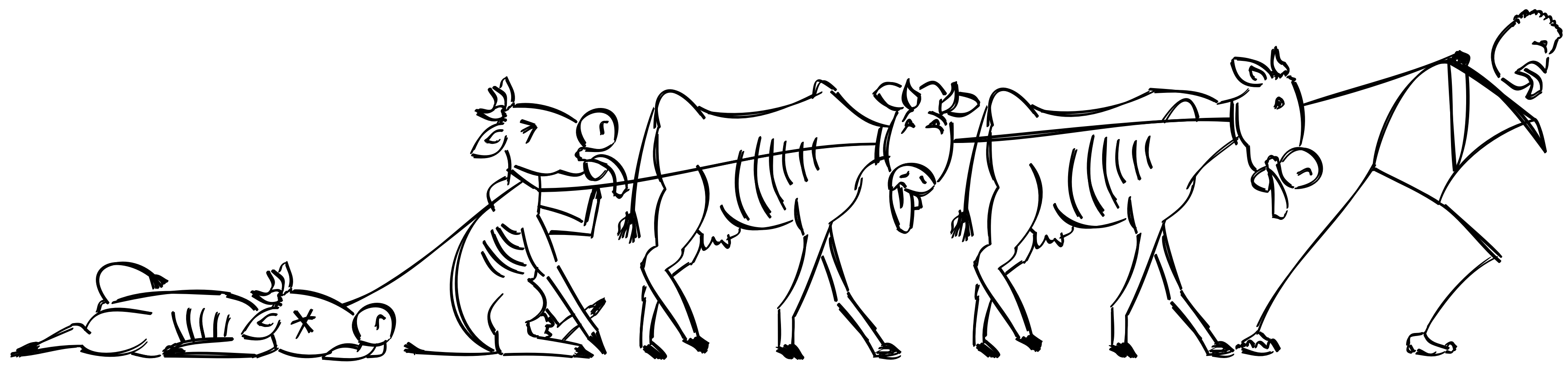
We Westerners then think, These people are insane. But then I come home from our trip and think, We’re just as freaked out. What do we in the West invent, produce, buy and collect by way of ‘cows’—things, apps, gadgets, toys and monthly bills—just to be able to show and tell? How many derive their self-image from the work they do, the money they make, the praise they reap and the stuff they own?
And again, at what cost?

More is now so common that it’s become an end unto itself. Anything to produce more stuff, make more profit, get more out of ‘your’ business, get more out of ‘your’ people, get more out of yourself, earn more, buy more, do more… be more.
Give children space to follow their hearts and help coworkers to flourish? Great, but only if hearts and flowers make them more effective in performing and delivering.
For a while, I was pretty judgmental about all of this, but as in competition and banking, so in our collective thirst for more I now see a wonderful kernel of truth.
We humans deeply long to experience life
in all its limitless richness.
We long to fully take in all of life’s colours,
to never stop exploring,
and to keep quenching ourselves
with the magic of existence.
The problem is not our longing for more; it’s seeking the limitless in the wrong places. Unconsciously hoping to find fulfilment in things, inauthentic ambitions and inflated self-images creates a vicious cycle. The more we seek, the less fulfilled we feel, the more we seek in the hope of still finding fulfilment, the even-less fulfilled we feel…
To me, this is the absolute poverty of never enough: a society in which it’s become normal to fend off avenues that feel vibrant, creative, valuable or meaningful, and instead do this now for fear of that later.
To give some examples, do you recognise any of the following?
- If I don’t take boring school subjects now, I won’t be able to go to university later.
- If I don’t get that degree this year, I won’t find a job next year.
- If I don’t take this job now, I won’t have a good resume later.
- If I don’t do what the boss says today, I’ll be fired tomorrow.
- If I say ‘no’ now, I won’t stand a chance later.
- If I don’t join the gang now, I won’t have any friends tomorrow.
- If I don’t follow this course now, I’ll have stumped my development later.
- If I rest now, I won’t finish it in time.
- If I stop rowing today, I’ll be a loser tomorrow.
Maybe you don’t—I recognise all of the above. Each of these beliefs I’ve allowed to bullshit me, usually without realising it, sometimes knowing very well I was bullshitting myself. And still the bullshitting happens, albeit in increasingly subtle ways. Fear has a wonder-filled tendency to turn illusion into reality.
